Insights

Helping not-for-profit organisations develop and sustain
the highest levels of employee and volunteer engagement
Insights
The impact of your employee and volunteer surveys is determined by the action that you take on the results. However, the effectiveness of action planning processes vary from organisation to organisation.
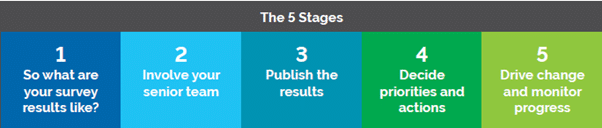
There are 5 stages that we recommend including in your action planning process.
Imagine being asked this question by your Chief Executive or Director General. You would want to be able to make 3-4 points and feel confident about the underlying evidence.
Some of the things to look for:
Armed with your analysis, you will want to start planning:
 2 Involve your senior team
Little change will be possible if the senior team are not playing an active role in shaping the way forward, and staff will want to hear what the senior team makes of the survey results.
If there is scepticism, and particularly if it is your first survey for a while, you may want to move forward one step at a time. For example, sharing the results with the Chief Executive and other senior leaders first and building consensus on the messages and way forward.
You will want to enable a senior team discussion of the survey results, covering:
After an initial discussion, many senior teams find it helpful to hold a retreat to discuss and agree the way forward in more detail. You may find it helpful to undertake further analysis to understand whether an issue is widely shared or more experienced by particular groups.
Being open about the survey results sends an important signal that leaders are listening and that people’s views matter. It is an essential building block for the conversations that need to happen.
The most common approach is to invite everyone to a ‘Town Hall’ meeting. What often works best is to present an overview of the results first and then for the Chief Executive to set out their assessment of the positives, areas for improvement, and map out the plan for moving forward. This is usually followed by making the organisation-wide results available to everyone.
Publishing departmental results requires thinking through the following questions:
Should survey results be published at team level or stop at departments? We encourage organisations to go as far as possible. A team manager will find their own results report much more insightful than having the responses for their team subsumed within a larger departmental report. You’ll of course need to consider confidentiality implications when breaking results down this way.
We often see organisations taking a sequenced approach to publishing results – starting at directorate level and then moving to departmental and team levels. Some organisations publish all the reports at the same time.
There are two approaches:
We find that most organisations adopt approach A. It keeps the process tight and reduces the risk of blame and defensiveness particularly for those managers with less strong results.
However, approach B is more open and transparent. It can increase accountability and encourages managers to learn from others who are performing well.
Some of our clients like to prepare a 1-page summary to accompany departmental reports, helping managers to see the key points quickly. Data visualization can be helpful when publishing your survey results.
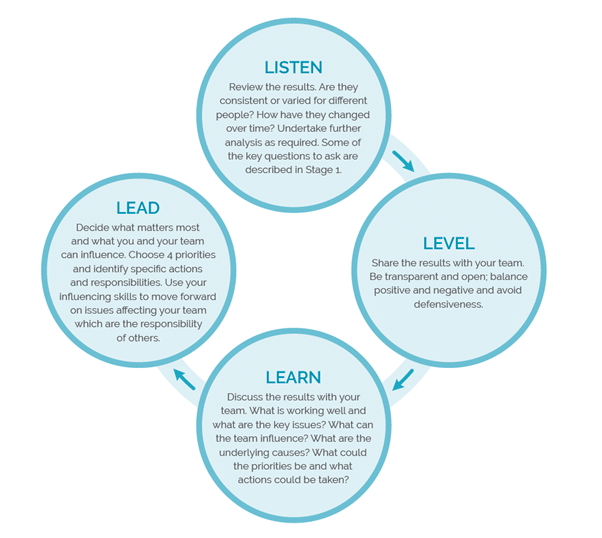
The 4 L model sets out a good methodology for deciding priorities and actions.
You may wish to capture your decisions in an action planning template – download the action planning guide to see an example template.
When teams have completed their action plans it may be helpful to capture these in a database to enable tracking of progress. The Reflections action planning module enables you to keep track of progress on actions in the same platform as your survey results dashboard.
As you monitor progress you may wish to consider:
In our guide ‘Taking action from your survey – A guide for leaders and managers’ we provide real examples of actions taken by not-for-profit organisations. We also share our 5 recommended strategies for effective action planning. Download the free guide here.
Does your action planning process need some structure and support? Get in touch with an expert at Agenda.










5 Linford Forum
Rockingham Drive
Milton Keynes
MK14 6LY
UK
Company No: 4509427