Insights

Helping not-for-profit organisations develop and sustain
the highest levels of employee and volunteer engagement
Insights
 In the not-for-profit sector, colleagues often want to give their best each day, to reach their potential and deliver on the organisation’s mission.
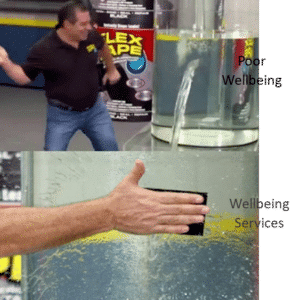
In fact, reaching our potential and contributing to our community is a hallmark of good mental health (WHO). However, poor wellbeing can undermine this. It dampens engagement, productivity, service quality, and exacerbates sickness and attrition.
To address this, organisations have turned to wellbeing services and programs. But are these the answer?
In this blog we will share our findings from our work with HR professionals, and research from working with numerous organisations on their health and wellbeing surveys to explore:
 We asked a group of 80 HR professionals from not-for-profit organisations what initiatives they’ve undertaken to improve wellbeing and mental health in their organisations. The most common initiatives were:
At Agenda, we have our own wellbeing team whose main focus is to share information and resources about mental health and living a healthy lifestyle. Several members of our team have also completed the MHFA training, which we found really insightful. The course was accessible and useful for our professional relationships and personal lives.
The good news is that your wellbeing services are, on the whole, well-received!
For staff that use the services offered, almost 9 in 10 are satisfied. Unfortunately, less than 1 in 3 people actually utilise them.
For those who hadn’t used the wellbeing service, over half reported the reason being that they were not aware of it. This means, over a third of the total workforce are not using the service, due to lack of awareness.
More good news, the appetite is there.
There is a real desire for wellbeing services, with 37% of staff feeling ‘more support services from the organization’ would make the most meaningful impact to their own wellbeing and mental health. While over a third feel more support services would also make the most meaningful difference to the wellbeing and mental health of their organization.
The top 5 services that organisations are offering (see above) address a number of the key areas of need reported by employees, including ‘training and coaching managers’, and a specific support for their mental health.
 However, employees would also favour programs aimed at improving their physical health (87%), and programs to improve their diet (54%) – programs absent from the top 5 most common wellbeing services currently being offered.
Above all, employees want support with their workload. A work overload is consistently cited as the top culprit for stress.
Workload management comes out on top when employees are asked what could make the most meaningful impact to wellbeing and mental health – above support services.
Employees feel their wellbeing would benefit most from more realistic deadlines and better workload allocation.
Yes! And no…
Your wellbeing programs are valuable, and largely well-received. There is a clear appetite for wellbeing services, and implementing the right programs to suit your people will add a lot of value to your organisation. It is clear from the data above that increasing awareness of the services available should not be overlooked.
But are your employees overloaded? Unrealistic workloads might be undermining the impact of your wellbeing programs.
Mindfulness apps, training, counselling, and yoga classes will be effective for many, but only for those with the capacity to engage with them. For others, those without a moment to breathe, they may be received as a distraction, a saddlebag on an employee already stumbling under the weight of their work.
Your wellbeing programs won’t be everyone’s cup of tea, and many will already have found their balance at work. For the majority however, pairing the right programs with a manageable workload could enable them to find their own balance. It is important to address the causes of poor wellbeing rather than just the symptoms.
The best way to understand how your people feel about your wellbeing services and programmes is by asking them! Many not-for-profit organisations that we work with are including questions about wellbeing and mental health in their employee and volunteer surveys. We have also had the pleasure of working with a number of HR leaders on focused wellbeing surveys.
If you’d like to speak with a survey expert about how to understand how your people feel about wellbeing services and programmes, get in touch!











5 Linford Forum
Rockingham Drive
Milton Keynes
MK14 6LY
UK
Company No: 4509427